Choosing a psychometric assessment provider is a strategic recruitment decision. The assessment platform you select will influence candidate experience, recruiter workload, hiring-manager confidence and the quality of evidence used in selection.
The market can look crowded because many providers offer personality questionnaires, aptitude tests or screening tools. The differences become clearer when you look beyond the headline test library and examine how well the provider supports the full decision-making process.
Start with the science
Psychometric assessments should be reliable, relevant and appropriate for the decisions being made.
Every single Clevry personality questionnaire and cognitive ability test have been developed and refined through over 30 years of extensive research with organisations and are accredited by the British Psychological Society (BPS). Our platform is ISO certified and uses norm-referenced scoring, which compares a candidate’s result with a relevant group of people who have previously completed the assessment.
The platform also provides different comparison groups and can create bespoke norm groups for organisations with larger candidate volumes.
That scientific foundation matters because attractive software cannot compensate for weak assessment design.
Check the breadth of assessment
The right assessment depends on the role. A provider should therefore offer enough variety to measure different job requirements without forcing employers into one standard package.
The Clevry assessment platform provides personality questionnaires, ability tests and situational judgement tests, alongside assessment centre exercises, virtual assessment options, 360 feedback and bespoke test design for those with more custom/niche requirements.
Our ability test suite covers verbal, numerical, abstract, checking and mechanical reasoning at different difficulty levels. This allows organisations to choose assessments that reflect the cognitive demands of different job families.
Look for genuine customisation
A generic assessment may be appropriate for some roles. Others require a closer fit with organisational values, competency frameworks or specific job demands.
Employers can create bespoke personality questionnaires by selecting the scales most relevant to the role. They can also structure reports under their own headings, allowing assessment to align more closely with existing competency or values frameworks.
We recommend using at least nine scales and generally no more than 30 in a bespoke personality questionnaire, balancing breadth of insight with candidate experience.
Ask how job matching works
A useful assessment provider should help you interpret results in the context of the role.
A role that involves extensive independent work may favour different tendencies from one that depends on constant social interaction. A highly structured role may require a different behavioural profile from a role built around experimentation and ambiguity.
Once a questionnaire is job matched, the platform can generate a Selection Report (along with a number of other useful reports) describing the degree of fit between the candidate’s results and the role requirements.
Evaluate the reports
Ask to see sample reports before selecting a provider.
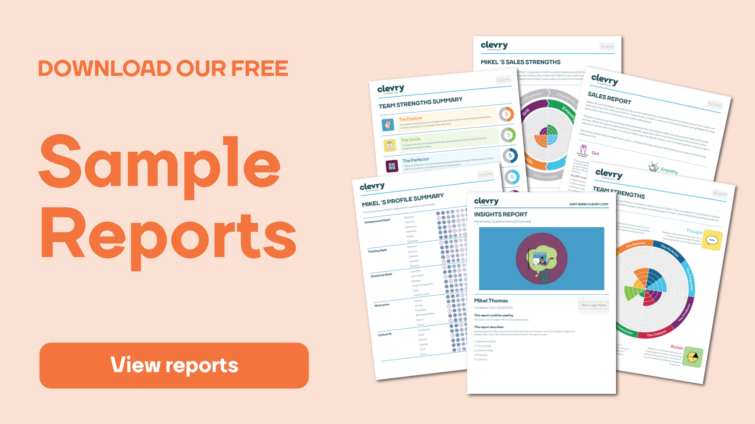
With Clevry multiple reports can be yielded from a single personality questionnaire. The Insights Report describes the individual’s personality profile. The Selection Report focuses on job fit. The Interviewer Report provides questions and guidance based on the candidate’s profile. Ability Reports explain cognitive assessment performance.
The same personality data can also support Onboarding, Team Strengths, Sales and Leadership reports where the appropriate questionnaire has been used.
This reduces the risk of psychometric results becoming an isolated document that nobody uses after recruitment and extends the life and value you get from your assessment process.
Consider candidate experience
Candidates judge the organisation through the recruitment process. Long, confusing or irrelevant assessments can create a poor impression.
Ask providers about assessment length, practice materials, accessibility, mobile experience and the relevance of test content.
All Clevry ability tests begin with practice questions. The online assessment experience includes work-relevant scenarios and progress information, while bespoke personality questionnaires can be kept focused on the characteristics that matter.
Situational judgement tests also provide realistic workplace scenarios, which can help candidates understand the nature of the role while the employer gathers behavioural evidence.
Review operational efficiency
The assessment platform needs to work for recruiters as well as candidates.
With Clevry employers can group assessments for a vacancy, recruitment programme or development activity. Recruiters can configure campaign settings, manage candidate progress and use automatic registration and response emails.
Candidates can be invited individually, through a campaign link or through bulk upload.
For broader processes, Clevry can include application forms, recorded video interviews, written exercises and psychometric assessment within one candidate journey.
Ask each provider how much manual work remains after implementation. Small administrative steps become significant when candidate volumes increase.
Check integration requirements
Assessment should fit with the recruitment systems the organisation already uses.
Clevry supports numerous ATS integrations, enabling assessment to form part of a wider recruitment technology workflow.
Before buying, clarify how candidate data moves between systems, what triggers assessment invitations, where results appear and whether recruiters will need to duplicate tasks.
Examine support and training
Technology is only part of psychometric implementation.
We provide all users with onboarding training, hiring-manager resources, customer support and an extensive Help Centre, which suggests that assessment results should always be considered alongside other candidate information and that personality scores represent preferences rather than objective measures of competence.
Make the decision against your own use case
The best psychometric assessment provider is not necessarily the one with the most tests or the most elaborate interface.
Choose against the problems you need to solve.
If you recruit at volume, focus on automation, sifting, reporting and integration. If you recruit specialist roles, focus on test relevance and customisation. If hiring-manager adoption is weak, prioritise reports that are easy to interpret. If the organisation has its own competency framework, look for flexibility in questionnaire design and job matching.
Clevry combines psychometric assessment, configurable campaigns, job matching and practical reporting within one platform. That makes our platform particularly useful for organisations that want to hire using a scientific assessment without losing flexibility.
The right provider should make your recruitment process more evidence-led, more consistent and easier to operate. If it cannot show how it will achieve those outcomes in your organisation, keep looking.
Speak to the team and we would be happy to answer any questions you might have or show you a quick demo of the platform in action.