
The ROI (return on investment) for psychometric tests is rarely captured by one number. A strong assessment process can affect recruiter workload, shortlisting speed, interview efficiency, hiring consistency, early retention and the quality of people selected.
Start with the current cost of hiring
Before measuring the value of assessment, establish the cost of the existing process.
Useful inputs include:
- the number of vacancies filled each year
- average applicants per vacancy
- recruiter time spent screening applications
- hiring-manager time spent reviewing candidates
- number of interview stages
- average time to hire
- early attrition rates
- the cost of restarting recruitment when a hire leaves
The figures do not need to be perfect. The purpose is to create a baseline that can be compared with the process after psychometric assessment is introduced.
Measure recruiter time
Suppose recruiters currently review hundreds of CVs manually before deciding who progresses. Even a few minutes per application can create a substantial workload when multiplied across multiple vacancies.
Clevry allows employers to create assessment campaigns and invite candidates individually, through campaign links or in bulk. Campaign settings can include automatic registration and response emails, helping reduce repetitive administration.
Ability tests and situational judgement tests can also provide more standardised evidence that supports early sifting where candidate volumes are high.
To calculate the potential saving, estimate:
- number of candidates processed
- average screening time per candidate
- hourly cost of recruiter time
- the percentage of screening activity that could be reduced
Measure interview efficiency
Poor shortlisting creates costs later in the process.
If too many weak candidates reach interview, recruiters and hiring managers spend time conducting conversations that are unlikely to result in a hire.
Psychometric assessment can provide additional evidence before interview.
Our job-match feature allows employers to define preferred ranges on relevant personality scales. A job-matched questionnaire can then generate a Selection Report showing the degree of fit between the candidate’s assessment results and role requirements.
The Interviewer Report can also suggest questions based on a candidate’s personality profile, giving interviewers areas to explore in more depth.
Track measures such as:
- candidates interviewed per hire
- interview hours per vacancy
- second interviews required
- hiring-manager time spent interpreting candidate information
Measure time to shortlist and time to hire
Recruitment delays create both operational and commercial costs.
Vacancies remain open. Managers spend more time supporting recruitment. Existing employees may absorb additional workload. In revenue-generating roles, the organisation may also lose productive capacity.
With Clevry you can centralise assessment activity and extend the process to include application forms, psychometric tests, video interviews and written exercises.
Track the time from application to shortlist before and after implementation. Then examine total time to hire.
Assessment should not be assumed to reduce these measures automatically. The value comes from designing a process that removes low-value manual steps and gives decision makers better evidence sooner.
Measure early attrition
A faster hire has limited value if the person leaves shortly afterwards.
Early attrition can be one of the most important measures in an assessment ROI model because replacement recruitment creates direct cost and disruption.
The assessment process should be built around characteristics associated with the demands of the role.
Our personality library includes more than 45 personality scales covering interpersonal style, thinking style, emotional style, motivation and culture fit. Employers can create questionnaires around the characteristics relevant to a role and use job matching to define the preferred profile.
Ability tests and situational assessments can help add further evidence where cognitive capability or workplace judgement is important.
Track retention at relevant points such as three, six or twelve months. Compare assessed hires with historical cohorts where the data is sufficiently similar to be meaningful.
Measure quality of hire
The largest potential return is also the hardest to quantify.
Quality of hire should be defined using outcomes relevant to the role.
For a sales position, measures might include revenue, target attainment or time to productivity. For customer service, they might include quality scores, attendance and retention. For a leadership role, performance reviews, engagement outcomes or progression may be more useful.
Once performance data exists, organisations can look for relationships between assessment results and later outcomes.
The goal is not to assume that every high assessment score predicts high performance. It is to identify whether the particular assessment process helps distinguish people who subsequently perform well in that organisation.
Include post-hire value
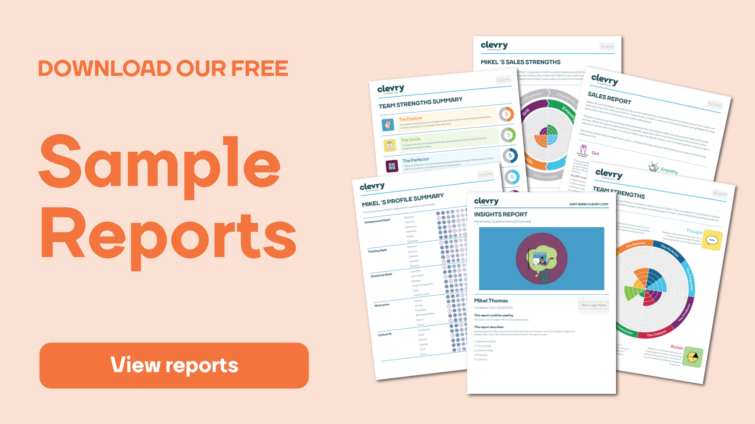
Clevry users can generate multiple reports from the same personality questionnaire, extending the life and value of your assessment platform. The Onboarding Report for example, helps line managers understand the successful candidate’s working preferences, strengths and motivational drivers.
Depending on the questionnaire completed, the data can also support Team Strengths, Sales Reports and Leadership reports.
Use a simple ROI formula
A straightforward calculation is:
Total estimated annual benefit minus annual assessment cost, divided by annual assessment cost, multiplied by 100.
The annual benefit could include estimated savings from recruiter time, interview time, reduced replacement hiring and other measurable improvements.
For example, do not write “psychometrics save 30 per cent of hiring costs” unless your own data proves it. Build the calculation from your organisation’s actual recruitment activity.
This makes the business case more credible and gives you a baseline for future review.
Review ROI by role
Assessment is unlikely to produce the same return everywhere.
High-volume roles may generate large efficiency gains because screening time is reduced across many candidates. Specialist roles may create more value through improved decision quality. Leadership assessment may be valuable because the commercial consequences of a poor appointment are higher.
Our highly flexible assessment model allows employers to vary the process by role rather than impose a single assessment journey across the organisation.
That flexibility should also shape ROI measurement.
The strongest assessment programme is one that keeps learning. Track cost, efficiency, retention and performance. Review whether the assessments are differentiating candidates effectively. Adjust the process where the evidence suggests a change is needed.
At Clevry we have been providing the tools needed to build that evidence for over 30 years. The ROI comes from how well those capabilities are connected to the recruitment outcomes your organisation cares about.
Speak to one of the team to find out more about how we can help you improve your recruitment process.