Home » Blog » How AI is changing hiring (and what it means for fair assessment)
How AI is changing hiring (and what it means for fair assessment)
Juha Nyyssölä
Artificial intelligence is already reshaping recruitment. From CV screening and interview analysis to candidate use of generative AI in assessments, the conversation has moved quickly from experimentation to real-world adoption.
For talent teams, that creates a difficult balancing act. There is pressure to adopt new AI tools, but also growing concern around fairness, transparency, candidate experience, and the quality of hiring decisions. At Clevry, we approach this with a simple principle: science leads, AI accelerates, and humans decide. AI can enhance efficiency and surface insights, but it should never replace the foundations of good assessment or remove human accountability from hiring decisions.
At the same time, organisations are starting to ask a new question: if AI is becoming part of many roles, how should that be reflected in the way we assess talent?
AI in recruitment is creating both momentum and anxiety
Few topics in talent acquisition currently generate as much noise as AI. New tools appear constantly, vendors make bold claims, and talent teams are often left trying to work out what is genuinely useful, what is overhyped, and what could introduce unnecessary risk.
This creates a familiar kind of pressure: the feeling that everyone else is moving faster, adopting more, and gaining an advantage. For many organisations, that fear of missing out can become a stronger driver than a clear understanding of what a tool is actually doing or whether it improves hiring outcomes.
That is where problems can begin.
Adopting AI simply because the market is moving in that direction is not a strategy. The more important question is whether a tool helps you make better, fairer and more defensible decisions.
In practice, this means stepping back from the noise and asking more grounded questions:
What is the tool actually evaluating?
How does it reach its outputs or recommendations?
Can its use be explained clearly to candidates and stakeholders?
Does it improve your process without undermining fairness or trust?
AI may be a significant technological shift, but the core principles of good assessment have not changed.
“No matter how cutting-edge the AI tool is, the same questions still apply: is it reliable, and is it valid?”
Dr Alan Redman
The ethics question is not optional
Bringing AI into hiring raises important ethical questions that can’t be overlooked.
Much of the debate focuses on bias, particularly where AI is used to screen CVs, analyse interviews or support decision-making at scale. There are valid reasons for concern here. Poorly designed systems can reinforce historical bias, especially if they are trained on flawed data or used without proper scrutiny.
At the same time, it is worth acknowledging that AI is not replacing some perfectly objective process. In many cases, it is being introduced into environments where decisions have already been shaped by human inconsistency, bias and error. The real challenge is not choosing between a biased human system and a flawless AI system. It is making sure automation does not make bad decisions faster or harder to challenge.
That is why transparency and accountability matter so much.
If a tool influences hiring outcomes, employers need to understand how it works well enough to explain and defend its use. That is increasingly important not only from an ethical perspective, but also from a regulatory one. As AI legislation develops, especially in Europe, explainability is becoming a more important expectation for organisations using AI in employment-related decisions.
In practical terms, this means employers should be able to answer questions such as: Why was this candidate screened out? What criteria were used? Was a human involved in the final decision? How do we know the tool is not producing unfair outcomes?
If fairness matters, audit it
One of the clearest points to come out of the webinar discussion was this: many organisations say fairness is important, but fewer are actually measuring it.
It is easy to say that bias and fairness are priorities when evaluating assessment methods. It is much harder, and much more valuable, to review whether your own process is creating adverse impact, favouring certain groups, or filtering people out for reasons unrelated to job performance.
If fairness is important to your organisation, it needs to be audited rather than assumed.
Candidate cheating is a real concern, but not a new one
One of the biggest anxieties surrounding AI in hiring is the idea that candidates can now “cheat” far more easily.
There is some truth in that concern. Generative AI can help candidates draft stronger CVs, generate answers for recorded video interviews, and support them in written exercises. New tools also make it easier to disguise that assistance.
But it is also important not to overstate the novelty of the issue. Candidate cheating did not begin with AI. Employers have long had to manage impression management, over-prepared responses, outside help, and attempts to game selection processes. AI changes the form this takes, but not the underlying challenge.
The more useful question is not whether cheating exists, but how assessment processes can be designed to reduce its impact.
At Clevry, we see this through three practical lenses: deterrence, disruption and detection.
1. Deter cheating where possible
Part of reducing cheating is reducing the motivation to do it.
That does not just mean threatening candidates with monitoring or penalties. It also means creating an assessment experience that feels fair, transparent and relevant. When candidates believe they genuinely have a chance to demonstrate their suitability, the impulse to game the process often decreases.
Clear communication matters here. Candidates should understand what is being assessed, how AI may or may not be used in the process, and what is expected from them.
“When people feel they have a fair shot, the impulse to cheat diminishes.”
Dr Alan Redman
2. Disrupt obvious opportunities to misuse AI
Assessment design still matters enormously. For example, if a verbal reasoning test allows long pauses, unrestricted browser behaviour and easy copying into external tools, it becomes much easier to outsource thinking to an LLM. If the task is time-bound, role-relevant and designed with care, that becomes harder.
Depending on the assessment method, practical safeguards might include:
time limits
browser restrictions
disabling copy and paste
monitoring for suspicious behaviour
designing tasks that require applied thinking rather than generic content generation
The goal is not to create a hostile process. It is to make low-effort misuse harder and signal that authenticity matters.
3. Detect and follow up where needed
No single safeguard will eliminate the problem entirely. That is why it is important to think about how suspicious behaviour is identified and what happens next. If something matters enough to assess early in the process, it should usually be examined again later in a different format.
This is one of the most effective ways to protect decision quality. If a candidate performs strongly in an unsupervised written exercise, can they demonstrate the same capability in an interview, live task or discussion-based assessment? Reassessment does not need to mean using the same test twice. It means checking key qualities through multiple methods.
That remains one of the strongest defences against distorted signals.
Candidate experience is part of the solution
One of the more overlooked points in discussions about AI and cheating is the role of candidate experience.
A poor candidate experience does not just damage employer brand. It can also increase suspicion, frustration and the sense that the process is impersonal or stacked against the applicant. That can make candidates more likely to justify using AI in ways the employer did not intend.
By contrast, a transparent and well-designed process can reduce that instinct.
This is especially important at a time when many candidates already suspect that AI is making recruitment decisions behind the scenes. If AI is being used, organisations should explain how. If it is not being used to make final hiring decisions, saying so clearly can help build trust.
Human involvement still matters. Candidates want clarity, consistency and the sense that a person remains accountable for important decisions.
The most important AI-related skills are still human ones
Much of the discussion around AI in hiring focuses on technology, but the real long-term shift may be in the skills employers prioritise.
As AI becomes more embedded in day-to-day work, organisations will need people who can use it responsibly, critically and effectively. These are not purely technical skills. In many cases, they are extensions of qualities that have always mattered, and are already measured effectively through structured tools such as personality assessments and cognitive ability tests.
From the webinar discussion, four areas stood out in particular.
Critical thinking
This is perhaps the most important one.
Using AI effectively is not just about getting an output. It is about evaluating that output, questioning it, refining it and knowing when not to trust it. Candidates who can apply judgement, challenge weak content and improve what AI produces are likely to add far more value than those who simply accept the first response.
Communication
Communication increasingly includes the ability to interact with AI tools well. Prompt-writing, instruction-setting and context-framing are all becoming more relevant in many roles. Strong communication is no longer only about how someone speaks or writes to other people, but also how clearly they can direct systems to support their work.
Emotional management
As AI changes jobs and workflows, it also changes the demands placed on people. Adapting to ambiguity, managing pressure, dealing with change and staying effective in a shifting environment are all increasingly important. Emotional management plays a role not only in leadership and teamwork, but in navigating AI-enabled work more generally.
Ethical judgement
AI use is rarely just a question of capability. It is also a question of judgement. When should AI be used? When should it not? What are the risks of relying on it in a given context? Can the user recognise issues around fairness, privacy, accuracy or accountability?
That kind of judgement is critical, especially in roles where decisions affect other people.
Good assessment still starts with understanding the role
One of the most important reminders from the webinar was also one of the simplest: good selection still begins with job analysis.
Before employers can assess AI-related skills, they need to be clear about whether those skills are genuinely relevant to the role and what “good” looks like in context.
Not every role requires the same level or type of AI use. In some jobs, prompting and content refinement may matter. In others, the emphasis may be on critical evaluation, ethical use or adapting to changing workflows. The goal is not to force AI criteria into every process, but to understand how the role is evolving and reflect that in a structured way.
That principle applies whether you are using psychometric assessments, work sample tasks, interviews or broader assessment processes. The closer the assessment is to the real demands of the role, the more useful and defensible it becomes.
What should employers ask AI assessment vendors?
The emergence of AI-enabled assessment tools has created a crowded market, and not all providers approach this space with the same level of rigour.
For employers evaluating vendors, the core questions are still the right ones, but they need to go beyond surface-level claims. The focus should be on evidence, transparency and real-world performance.
What evidence do you have that the tool is reliable and consistent over time?
How has the tool been validated for its intended use? (e.g. links to job performance, case studies, validation reports)
Can you explain, in practical terms, how the tool reaches its outputs or recommendations? (and could you explain that to a candidate if needed?)
What data has the model been trained on, and how do you ensure it is appropriate and unbiased?
How do you monitor and audit fairness in real client environments, not just in theory?
Where does human oversight sit in the process, and how are decisions reviewed or challenged?
No matter how advanced the technology sounds, employers should still expect clear evidence that it measures something meaningful, does so consistently, and relates to real job outcomes. A compelling demo is not the same as a defensible assessment method.
Moving forward with AI in hiring
AI is not going away, and for most employers the real question is no longer whether it will affect talent acquisition, but how to respond to it responsibly.
That response does not need to be either fearful or uncritical. The most effective position is usually somewhere in between: open to innovation, but grounded in evidence, fairness and practical judgement.
For talent teams, that means resisting the pressure to adopt new tools without fully understanding how they work, while keeping fairness and explainability front of mind. It involves designing assessment processes that are robust, transparent and closely aligned to the role, and recognising that candidate experience is not separate from assessment quality, but a core part of it. At the same time, it requires a more deliberate focus on the human skills that will matter most in AI-enabled roles, ensuring they are clearly defined and consistently assessed.
The technology may be changing quickly, but the fundamentals of good hiring remain strikingly familiar. Clear criteria, sound assessment design, human accountability and a fair process still matter. In many ways, they matter more than ever.
Watch the webinar on demand
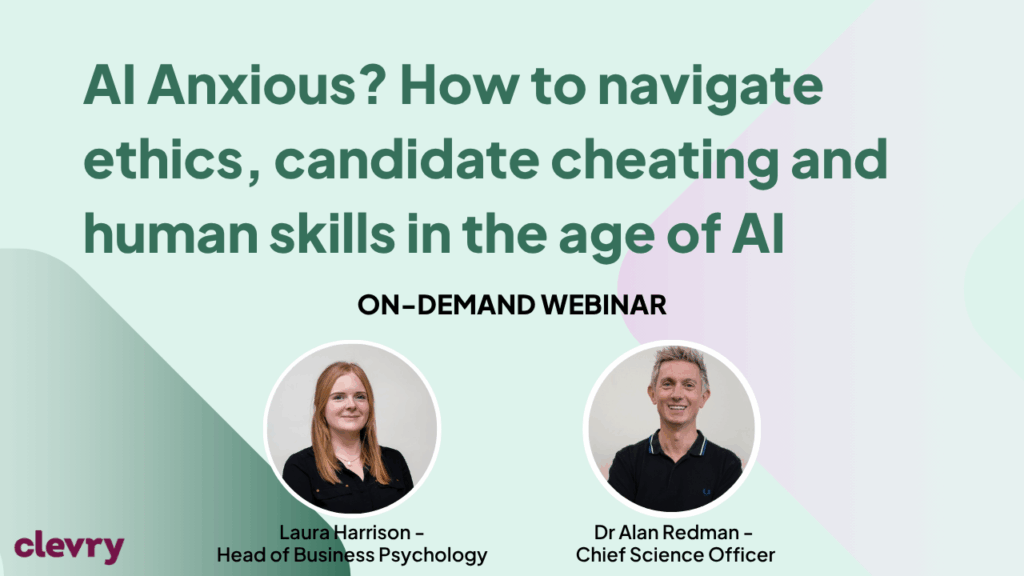
If you’d like to explore these themes in more detail, you can watch Clevry’s on-demand webinar, AI Anxious? How to navigate ethics, candidate cheating and human skills in the age of AI, where we unpack the practical implications of AI in talent assessment and hiring.