Recruitment teams rarely struggle because they have too little information.
The problem is usually the opposite.
Applications arrive through one system. Assessment links are sent from another. Recruiters export scores into spreadsheets, chase incomplete candidates by email, download reports, forward PDFs to hiring managers and manually update the ATS.
None of those tasks is difficult on its own. At scale, they consume a substantial amount of recruiter time.
Good psychometric test software should remove work from the process rather than create another system to manage.
The value is therefore not only the quality of the tests. It is the amount of administration, duplication and manual interpretation the platform can take out of recruitment.
Create one assessment campaign instead of managing multiple links
A common problem appears when an employer uses several assessment methods.
A candidate may need to complete a personality questionnaire, an ability test and a situational judgement test.
Without a central platform, recruiters may have to create separate invitations, manage several deadlines and combine the results manually.
Assessment campaigns simplify this.
Clevry allows employers to combine relevant psychometric assessments within a single campaign, giving candidates a more coherent process and recruiters a central view of progress.
That matters in volume hiring.
If hundreds or thousands of candidates are moving through a campaign, every manual step becomes expensive.
A platform should make it possible to configure the process once, then repeat it consistently.
Automate candidate communication
Recruiters spend a large amount of time on routine communication.
Invitations need to be sent. Candidates forget to complete assessments. Deadlines approach. Hiring managers ask whether results are ready.
Good assessment software should automate predictable communication.
This keeps candidates moving without requiring recruiters to send individual messages. It also creates consistency.
Every candidate receives the same core instructions and reminders rather than relying on how busy the recruiter happens to be.
Automation should not make the experience impersonal. Recruiters should still be able to intervene when a candidate needs support or an adjustment.
The purpose is to remove repetitive administration so people have more time for the conversations that actually require judgement.
Calculate and organise results automatically
Assessment data quickly becomes difficult to manage manually.
If recruiters are copying scores into spreadsheets, the organisation introduces delay and the possibility of error.
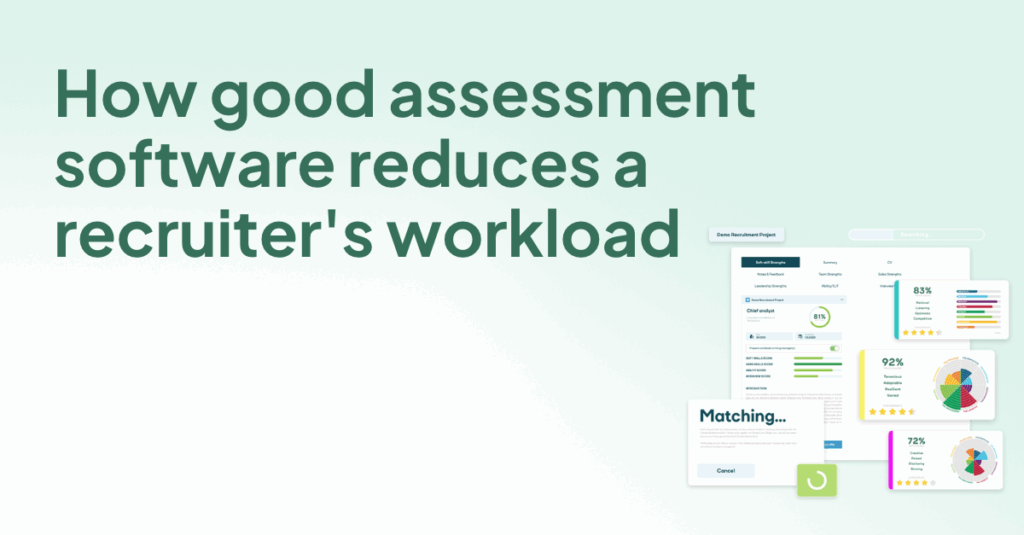
A platform should score assessments automatically and present results in a format that supports the next decision.
Clevry generates numerous psychometric reports from a single completed assessment and can provide job-matched Selection Reports where the campaign has been configured against role requirements, as well as onboarding and leadership reports which help extend the value of your assessment software beyond the initial hiring phase.
This reduces the need for recruiters to translate raw scores before a hiring manager can use them.
The software is doing the repetitive processing. The recruiter remains responsible for interpreting the evidence in context.
Make sifting easier
High-volume recruitment creates a simple mathematical problem.
If 1,000 people apply and every CV takes several minutes to review, the amount of recruiter time required becomes substantial before interviews have even started.
Assessment software can help move relevant evidence earlier in the process.
Ability scores, SJT results and job matching can support structured sifting.
This does not mean every organisation should automatically reject candidates based on a single score.
It means the recruiter can use consistent information to prioritise attention.
The platform should make it easy to identify candidates who meet defined requirements, view the underlying evidence and investigate borderline or unusual cases where needed.
This is far more efficient than repeatedly downloading reports and comparing people by hand.
Reduce duplication between recruitment stages
Another source of wasted time is repetition.
Candidates are assessed, then interviewed as if no assessment happened.
Recruiters collect information, but hiring managers ask the same questions again because the results have not been translated into something useful.
Good assessment software should carry evidence forward.
Our Interviewer Report uses personality information to suggest areas and questions for the interview.
This means the assessment stage can improve the next stage rather than simply deciding who gets through it.
The recruiter does not need to create a completely separate interview briefing for every candidate.
The report already identifies areas that can be explored.
Give hiring managers self-service information
Recruiters frequently become the interpreter between assessment software and the hiring manager.
The manager asks: “What does this score mean?”
The recruiter opens the report, explains the result and sends another document.
If every decision requires this manual translation, the software has not solved enough of the problem.
Reports need to be designed for the person using them.
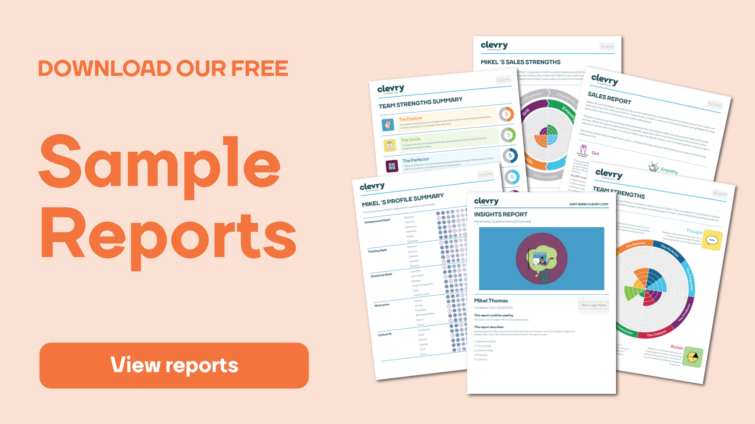
Our portfolio of reports includes Selection, Interviewer, Insights, Leadership, Team Strengths, Onboarding and candidate-facing reports.
Different users can therefore receive information suited to their task.
The hiring manager may need role fit and interview prompts. An L&D professional may need development insight. A line manager may need onboarding guidance.
Good software reduces dependence on the recruiter as the only person who can understand the assessment.
Centralise assessment data
Recruitment becomes harder when data is scattered across email, spreadsheets, shared drives and separate testing platforms.
A central assessment platform creates a consistent record of candidate activity and results.
Recruiters can see who has been invited, who has completed the process and what reports are available.
This is particularly useful when several recruiters or hiring managers are involved.
The team does not have to ask one person where the latest version of a report has been saved.
Centralisation also makes governance easier.
Organisations can control which assessments are used, how campaigns are configured and which reports are generated rather than allowing every recruiter to create a separate process.
Reuse proven assessment setups
Recruiters should not need to rebuild the same campaign every time a recurring role opens.
Once an organisation has defined a strong assessment process for a role family, the platform should make it easy to reuse it.
That improves efficiency and consistency at the same time.
It also allows the organisation to refine a process over several hiring rounds.
If the recruitment team learns that a particular assessment adds little value, it can change the campaign. If job analysis identifies a stronger set of criteria, the setup can be updated centrally.
The software becomes part of an operating model rather than a collection of one-off tests.
Support bespoke requirements without creating manual work
Some organisations need more than off-the-shelf assessments.
The role may be unusual. The competency framework may be specific. The candidate journey may need to reflect the employer brand.
At Clevry we have been combining assessment software with business psychology consultancy and bespoke test design for over 30 years.
This means organisations can create tailored personality questionnaires, situational judgement tests or other assessment frameworks while still delivering them through the same online platform.
Bespoke should not have to mean manual.
The goal is to create assessment content that fits your organisation while preserving the efficiency of automated delivery, scoring and reporting.
Integrate with the wider recruitment workflow
Assessment software becomes more valuable when it connects with the systems recruiters already use.
If recruiters still need to repeatedly move candidate details and status information between platforms, much of the administrative benefit is lost.
ATS-linked workflows can reduce double entry and help assessments sit within the recruitment process rather than alongside it.
For HR technology buyers, integration should therefore be part of the buying decision.
The question is not only “Can this platform run the test?”
It is “How much work disappears when this platform is in place?”
Measure the time saved
Recruitment teams should evaluate assessment software using operational measures as well as psychometric ones.
Useful questions include:
- How much manual screening has been reduced?
- How many candidate emails are now automated?
- How long does it take to create a new campaign?
- How quickly can hiring managers access reports?
- How many spreadsheets or offline processes have been removed?
- How much recruiter time is spent explaining results?
- Has time to shortlist changed?
These measures make the efficiency case tangible.
The benefit is not simply that technology performs tasks faster. It is that recruiters can spend more time on work that requires human expertise.
Good assessment software creates capacity
Recruiters add the most value when they are understanding roles, advising hiring managers, speaking with candidates, solving difficult hiring problems and improving the selection process.
They add less value copying scores between systems.
The Clevry assessment platform has been designed to automate much of the routine work around personality questionnaires, ability tests, situational judgement tests, job matching and reporting.
For recruitment teams, that can mean fewer disconnected tools, less administration and faster access to structured evidence.
The most useful assessment software does not simply digitise an existing process. It changes the workload.
It removes repetitive tasks, standardises what can be standardised and gives recruiters more time for the decisions and conversations where people still matter most.
Speak to one of the team and we would be happy to give you a quick demo of the platform and answer any questions you might have