
AI at work has moved from pilot projects to being embedded in infrastructure in the space of a few years. In hiring and assessment, the shift has been equally sharp. Tools that once supported narrow tasks now influence how candidates are filtered, evaluated, and ranked at scale.
Most organisations did not arrive here through a single strategic decision. Adoption has been gradual, often driven by vendor updates, new features, or pressure to keep pace with competitors. The result is widespread usage without the same level of control or understanding.
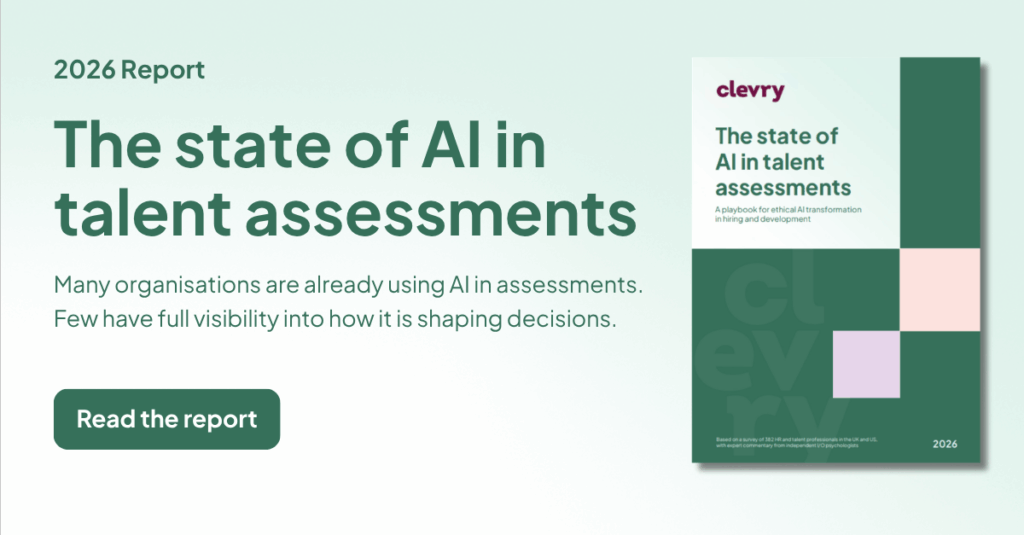
Our recent AI in Talent Assessments Report highlights this tension clearly. Among 382 HR and talent professionals we surveyed, 94% are using assessments, with over half confirming AI plays a role in how those tools operate. Along with that, a significant proportion either suspect AI is being used or do not know at all.
Adoption has outpaced understanding
The current phase of AI in talent assessment is defined by uneven visibility.
Many HR teams are working with systems that influence hiring outcomes without full transparency into how those outcomes are produced. In the report we refer to this as “shadow AI”, algorithms that can shape hiring decisions without clear oversight or explanation. Roughly one-third of respondents fell into this category.
From an operational standpoint, this creates immediate problems.
If a candidate challenges a decision, the organisation needs to explain how that decision was reached. If a system cannot be interrogated, the responsibility shifts back to the employer without the necessary evidence to support it.
There is also a strategic issue. When tools are implemented without a clear understanding of their function, they begin to shape the hiring process rather than support it. Over time, this leads to inconsistency across roles, regions, and business units.
The speed of adoption has created capability gaps. Teams are now expected to manage systems that require a different level of technical and analytical literacy than traditional hiring methods.
The perception gap around risk
Concerns around AI in hiring tend to cluster around two areas: unfairness and candidate manipulation.
Both are valid. Neither is as straightforward as it is often presented.
The report shows that 45% of respondents are concerned about inaccurate or unfair evaluations, while 43% are worried about candidates using AI to cheat. At the same time, only 26% have actually seen evidence of manipulation.
This creates a perception gap where anxiety amongst administrators is high, but direct experience is lower.
This however, does not reduce the importance of the issue, it just changes how it should be approached.
Overcorrection is a real risk. Heavy monitoring, restrictive controls, and overly rigid processes can degrade candidate experience without fully addressing the underlying problem. Poorly designed systems tend to create new vulnerabilities rather than remove existing ones.
A more effective approach focuses on good assessment design and use of a good psychometric test platform.
Generative AI performs well in producing written responses. It is far less effective at replicating behavioural patterns, decision-making under pressure, or consistent cognitive performance across varied tasks… for now.
Assessments that measure these elements are naturally more resistant to manipulation. Time constraints, interactive formats, and job-relevant simulations create conditions where external assistance becomes less useful.
Transparency is becoming a baseline expectation
One of the clearest signals in our report is what HR leaders actually want from AI tools.
Fifty-eight% said that clear explanations of how AI is used would increase their confidence. Close behind are demands for compliance assurances, bias reduction evidence, and the ability to test tools in real conditions.
Transparency needs to exist in practical terms:
- What data is being used
- How that data is processed
- How outputs are generated
- How decisions can be explained
Without this, organisations are relying on outputs they cannot defend.
There is also a regulatory dimension. AI systems used in employment decisions will be subjected to increasing scrutiny.
The audit gap is widening
The report found that there was a consistent mismatch between what organisations say matters and what they actually verify.
Eighty-seven% of respondents value fairness in assessment, while nly 38% admitted to conducting ongoing audits to check for bias or unintended outcomes.
Audit processes typically require:
- Access to relevant data
- Time and resource investment
- Clear ownership of responsibility
- Cooperation from vendors
As it stands many organisations do not have all of these in place.
As AI becomes more embedded, this gap becomes harder to ignore. Fairness cannot be established at the point of procurement and then left unchecked. Systems evolve, data shifts, and outcomes change over time. Continuous monitoring is required to maintain confidence in the process.
The organisations that close this gap early will have a structural advantage, they will be able to demonstrate fairness, respond to challenges, and adapt more quickly when issues arise.
Human accountability has not diminished
AI at work has altered how decisions are produced, but it has not changed who is responsible for them.
There is a tendency to view automation as a way to reduce human involvement. In hiring, this is not viable.
The report reinforces the importance of human oversight at every stage. AI is most commonly used in scoring, ranking, and generating assessment content. The final decision still (and should always) sits with a human.
That responsibility extends beyond the final decision point.
Human involvement is also required in:
- Selecting and validating tools
- Interpreting outputs
- Monitoring for bias or anomalies
- Explaining decisions when challenged
Accountability cannot be delegated to a system. It remains with the organisation and the individuals operating within it. This has implications for capability development. HR teams need a deeper understanding of how these tools function, not just how to use them.
Moving from adoption to control
The use of AI in hiring is no longer a question of whether to adopt, the focus has shifted to how it is managed.
The report points towards a more deliberate phase of adoption. One where speed is no longer the primary driver. Fairness, accuracy, and defensibility are becoming central.
This requires a different approach:
- Treat AI systems as components of a wider hiring strategy, not standalone tools
- Build internal capability to understand and challenge outputs
- Establish governance frameworks that operate continuously
- Prioritise transparency as a non-negotiable requirement
The organisations that approach AI in this way will move beyond reactive use. They will be able to use these tools with confidence, rather than caution.
The bottom line
AI at work has introduced a new layer of complexity into hiring and assessment. The benefits are real but so are the risks.
The difference between the two depends on how well the system is understood and controlled.
Adoption is already widespread. Confidence is not.
Closing that gap requires more than new technology. It requires clarity, discipline, and a willingness to question how decisions are being made.