The workplace has changed dramatically over the past 30 years. So why should the way we understand personality at work stay the same?
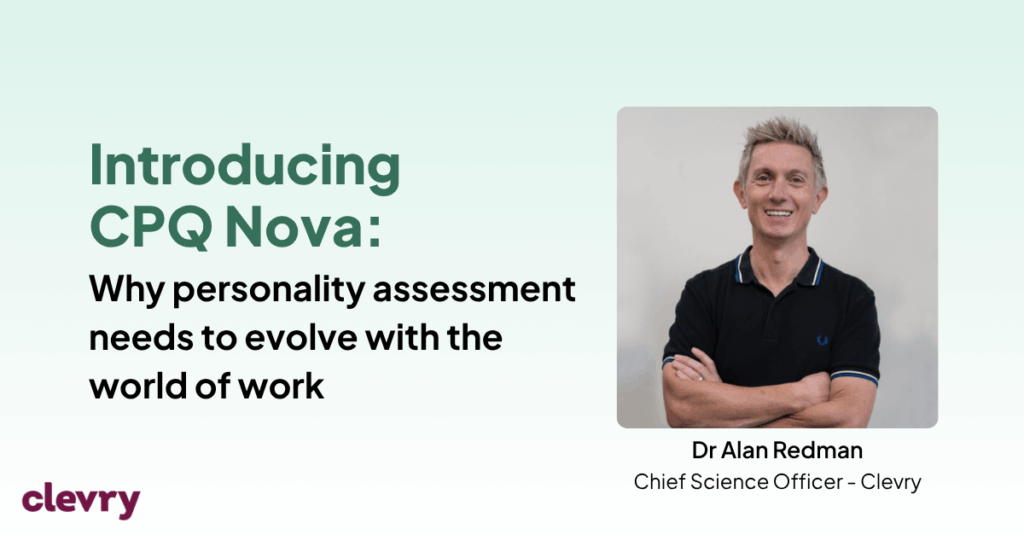
When Clevry’s personality questionnaire was first developed in the late 1990s, the world of work was already undergoing significant change. Desktop computers and the internet were transforming how people completed tasks, communicated and collaborated.
Yet many of the personality assessments available to employers had been created decades earlier and remained largely unchanged. The Myers-Briggs Type Indicator originated in the 1940s. The 16PF, once widely regarded as a gold standard for measuring personality, was developed in the following decade and, as Dr Alan Redman, Clevry’s Chief Science Officer, notes, never really changed.
Clevry wanted to take a different approach.
Rather than developing a fixed questionnaire with a set number of scales that would remain static for decades, the aim was to build a flexible scale library that could reflect the realities of the workplace.
Three decades later, that principle is just as relevant.
CPQ Nova, Clevry’s updated workplace personality questionnaire, represents the next stage in that evolution. Developed over three years, it combines the established foundations of personality science and rigorous psychometric methodology with new and refined constructs and updated language for today’s workplace.
The goal was not to reinvent human personality. It was to understand it more precisely in a working world that looks very different from the one we knew 30 years ago.
“We’re still human beings, but the way that personality had to be expressed in the workplace had changed. The demands that were being placed on people had changed.”
Work has changed. Personality assessment needs to keep up
The fundamental building blocks of personality have not suddenly changed. People are still people. But the environments in which they work, and the expectations placed upon them, have.
The past three decades have brought major shifts in how, where, and why we work. Portfolio careers, side hustles, greater movement between jobs and professions, remote and hybrid working, and rapidly evolving technology have all contributed to a less structured world of work.
The COVID-19 pandemic accelerated many of these trends, rapidly bringing forward ways of working that had previously been viewed as part of the future.
Roles themselves have also become more fluid. People may have greater opportunities to shape their responsibilities around their strengths, while organisations increasingly need employees who can adapt as jobs, technology, and expectations evolve.
Dr Alan contrasts this with a more traditional model in which the organisation defined the role and the individual was expected to fit within it.
“Work itself was less structured and concrete in terms of: this is the job, these are the demands, and you’ve got to fit that.”
This has important implications for personality assessment.
“We haven’t invented extra bits of undiscovered personality,” Alan says. “It’s still just human personality. Most of it will boil down to the Big Five in research terms. It’s the way those things are expressed in the workplace.”
For CPQ Nova, this meant retaining constructs that remain closely connected to the foundations of personality while reviewing the wider library more fundamentally. Existing scales were refined or restructured where needed, new constructs were introduced as the research allowed, and the underlying items and measurement were redeveloped to improve their relevance, precision and predictive value.
Characteristics such as assertiveness, attention to detail, calmness, optimism and stress management remain important. But alongside these established constructs, CPQ Nova offers a more contemporary and precise understanding of how personality influences working life.
Beyond skills: Understanding what drives people at work
One of the biggest changes Alan has observed over the past decades is the growing importance of organisational culture and values.
Employers now communicate much more explicitly about who they are, what they stand for and the environment they want to create. Candidates, meanwhile, increasingly consider whether an organisation’s purpose, reputation, and values align with their own.
The original Clevry questionnaire was already unusual in treating values and motivations as part of personality at work. At the time, many assessments concentrated on visible behavioural traits, while motivation might be measured through an entirely separate questionnaire.
Clevry took the view that the behaviour people display at work cannot always be understood without considering what drives it.
That has become even more relevant as culture has moved towards the centre of recruitment and talent management.
Skills remain critical. But when two candidates have comparable skills, a different set of questions becomes important: who is likely to feel motivated by the work and want to remain in the role?
“When you’ve got two equally skilled people, who’s going to feel more motivated and more culturally compatible with the job and with the organisation?”
CPQ Nova reflects this shift through a greater focus on workplace values and motivations.
The updated library explores areas such as whether someone wants to work for an organisation they perceive as a force for good, and whether they are motivated by doing work that benefits other people or society more broadly.
These motivations are not new. However, sustainability, social responsibility, ethics, diversity, and inclusion have become more prominent in how people think and talk about working life.
Alan also sees a generational shift in how people identify with work. Previous generations may have associated themselves strongly with their profession, trade, or chosen career. Today, people may be more likely to consider what their employer represents and how working there reflects their own values.
The organisation’s reputation and wider impact can therefore influence not only whether someone applies, but whether they feel proud and motivated to work there.
Strengthening the science behind the assessment
CPQ Nova was not developed simply to reflect social and organisational change. It was also an opportunity to draw on developments in psychological research and strengthen the questionnaire’s psychometric performance.
Some qualities have been discussed in the workplace for years without being defined precisely enough to assess as distinct psychological constructs.
Empathy and productivity are good examples. Both have appeared in job descriptions for years, but historically they were often too broadly understood to assess meaningfully.
As the research developed, Clevry was able to examine these constructs more precisely and incorporate them into the new scale library.
The development process also involved reviewing whether existing scales continued to measure one coherent characteristic, creating and testing new questionnaire items, examining scale structures and assessing impression management.
Alongside relevance, the questionnaire needed to maintain the scientific qualities expected of a professional psychometric assessment. Alan describes this as the “boring, nerdy psychometric stuff”, but it was fundamental to the project: making the scales as reliable, precise, and predictive as possible.
Inside a three-year development programme
| Reviewing the evidence Literature reviews and analysis of the Legacy CPQ helped identify what to retain, what to refine and which workplace traits needed to be better represented. | Developing and refining new measures New and reworked scales were developed around clearly defined constructs, with items written and refined to measure each trait as precisely as possible. |
| Expert qualitative review Psychometric experts reviewed scales and items for clarity, relevance and inclusivity, with specific consideration given to equity, diversity and inclusion (EDI), as well as ambiguity, idioms and culturally biased language. | Repeated quantitative testing Multiple rounds of trialling assessed reliability, score distributions and item performance, including how each scale related to impression management, to help ensure the scales are appropriate for use in selection and development contexts. |
| Testing validity, fairness, and stability Analysis examined scale structure, demographic group differences and stability over time, alongside mapping the CPQ to established personality frameworks such as the Big Five. | Aligned with professional standards Development and analysis followed the EFPA Psychometric Test Review Model, providing a rigorous framework for evaluating the quality of the assessment. |
This level of redevelopment is uncommon. Organisations build recruitment and development processes around established assessments, while practitioners become familiar with their scales, reports and interpretations. Making fundamental changes can therefore be disruptive for both the publisher and its customers.
“It’s quite difficult updating a personality questionnaire, so publishers tend not to do it, and certainly don’t tend to do it in a very wholesale way. It’s disruptive to the business. It took us three years, starting from scratch.”
The result is not a rejection of the original CPQ. The strongest parts of the existing library have been retained and improved. But the development team was also prepared to introduce new constructs and restructure older scales where the research and practical evidence supported a more precise approach.
A more precise language for personality
Language shapes how people understand personality. As the workplace evolves, so does the vocabulary used to describe behaviour, motivation, and individual differences.
Sometimes, an existing scale remains relevant but requires clearer or more contemporary language. In other cases, years of practical use reveal that one broad scale is attempting to capture more than one distinct idea.
The former Caring scale is one example.
As Alan explains, the scale examined whether someone gained fulfilment from providing care, service, help, or support to others. This could be relevant to nursing, but it might equally describe a manager motivated by supporting and developing their team.
However, the label did not always translate naturally across working environments. A bank, for example, might want people who support one another without describing the work itself as a caring profession.
The scale also contained two different motivations. One concerned whether someone wanted to work with self-reliant colleagues rather than continually resolving other people’s problems. The other was more directly about wanting to perform work that helps others or contributes to society.
CPQ Nova separates these ideas so they can be assessed more precisely.
A similar issue emerged with the former Striving scale, which combined achievement orientation with the motivation to remain busy and active.
Alan describes these as “two scales inside it fighting to get out”. In CPQ Nova, they have become clearer, separate constructs.
The scale names themselves were also carefully considered.
For decades, Clevry has trained practitioners to focus on full scale descriptions rather than relying solely on familiar labels. Words such as “assertive”, “friendly” or “listening” can mean different things to different people and may carry assumptions about which result is desirable.
“We’ve consistently advised people not to rely on scale names alone. They’re broad and can mean different things to different people. The scale descriptions provide the context needed to understand what each scale actually measures.”
With CPQ Nova, the development team decided to challenge those assumptions more directly.
Where a scale name might suggest that one end is inherently better, the language has sometimes been flipped. Rather than presenting Listening as the obviously desirable end of a scale, for example, the opposite end can be described as Talkative.
“There’s nothing inherently wrong with being talkative. Lots of jobs require you to be talkative.”
The relevance of either tendency depends on the job and context.
Other scale names are deliberately less familiar. Severance is one of the clearest examples.
The Friendship scale looks at the extent to which someone values close personal relationships and a social life at work. At one end sits Friendship, describing people who are motivated by developing close relationships with colleagues. At the other sits Severance, reflecting a preference for greater professional distance and keeping work and personal life more separate.
As Alan puts it: “At the other end, it was more: I like to keep my life separate. I’ve got my work life and my work friends, and I’ve got my home life and my home friends.”
Severance is not a word most people use in everyday conversation, and it may initially make an assessor pause. That pause is intentional.
Severance versus Friendship
An obscure English term meaning to keep separate – and one end of a scale focused on the tendency to keep work life and home life apart. At face value, you might mistakenly believe that the other end of this scale, Friendship, is the nicer way to be. But the CPQ Nova scales have been designed intentionally at every stage, and that includes the names of the scales themselves. Severance does not let you skim past, and that pause is intentional.
“When you see someone scored high on Severance, you’ve got to think about that. You’ve got to look at the definition and find out: ‘Oh, I see. That means you keep your work and home life separate.”
The intention is to encourage practitioners to look beyond familiar labels and the assumptions they may carry.
“It’s to encourage more thoughtful, critical thinking around what this instrument is actually saying. What is it actually telling me about the individual?”
There is no universally good personality profile
The choice of language also matters because personality questionnaires used in hiring operate in a high-stakes environment.
Candidates naturally want to make a positive impression, whether they are completing a questionnaire or answering questions in an interview.
If a scale has an obviously “good” and “bad” end, people may respond according to what they believe the employer wants rather than how they genuinely see themselves.
This can be a particular challenge with broad personality frameworks.
The Big Five provides an academic foundation for understanding personality, and the CPQ scales can ultimately be related back to broader underlying factors. But presenting those broad factors directly in a hiring context can create problems.
“The trouble with the Big Five is that at least three of the factors seem to have an obvious good end. It’s hard to be low on conscientiousness and not feel bad about yourself.”
Even someone who does not naturally see themselves as highly conscientious is likely to recognise that conscientiousness sounds desirable when applying for a job.
CPQ Nova was developed with this challenge in mind. New items and scales were examined for their relationship with impression management, while expert panels reviewed the wording to identify items that appeared too socially desirable.
The objective was to develop scales in which both ends represented coherent and potentially valuable ways of approaching work.
The new Proactive scale provides a useful example.
At one end may be someone who notices that a process is not working and tries to change it. At the other may be someone who adapts their own approach and finds an effective workaround.
“You can either try and change it,” Alan explains. “Or you think: right, I need some workarounds. I’m never going to change that. I’m going to find a way.”
That is a central principle of responsible personality assessment: a high score is not automatically good, and a low score is not automatically a weakness.
Personality assessment in the age of AI
Artificial intelligence adds another dimension to the evolution of workplace personality assessment.
As AI changes how work is performed, the human qualities that remain difficult to automate may become even more important.
For Alan, one of the most important capabilities in an AI-enabled workplace is critical thinking.
This is not simply a question of cognitive ability. It also concerns a person’s inclination to question information, challenge assumptions and think carefully about what is placed in front of them.
“The biggest workplace skill at the moment is being able to challenge, question and be mindful about what you’re seeing and what you’re reading.”
AI can produce an answer quickly. But speed does not necessarily equal quality.
Alan is particularly interested in what may happen as people enter the workplace having always had access to an AI assistant. They may have had fewer opportunities to develop the habit of working through difficult questions, challenging the first available answer or learning through the process of solving a problem.
Organisations are currently encouraging employees to use AI largely to become faster. The longer-term value, however, may depend on whether people can use it to reach better answers, not simply quicker ones.
CPQ Nova includes constructs such as intellectual curiosity and conceptual thinking, which provide insight into how someone tends to approach ideas, information and complex problems.
An ability test can provide evidence about whether someone has the capacity to reason through a problem. Personality assessment can help explore how naturally inclined they are to investigate, question and engage with it.
So, has AI made personality more or less important in hiring?
Alan’s answer is immediate: more important.
When the original CPQ was being developed, he was experiencing another significant technological shift first-hand.
“I remember Windows 3.1 being introduced to the firm I was working for. It was a big deal. I remember jobs going because copy typists weren’t required any more, dictaphones weren’t used any more, and all this stuff was disappearing.”
At the time, the ability to accommodate change in the workplace became particularly important. AI now represents another major transition, reshaping established tasks, roles and ways of working.
As technology automates more routine activity, organisations will need to think carefully about what they are employing people to contribute.
“If we are going to be employing people into jobs which are different because a lot of the routine is automated, then what are we employing them for? It’s got to be their humanness, their personality.”
Are organisations assessing the right things?
Organisations sometimes assess the wrong qualities, or identify the right qualities but rely on the wrong evidence when making their decisions.
Terms such as “common sense”, “proactivity”, “empathy”, and “customer service” are common in recruitment. Unless they are clearly defined, however, they can mean something different to every person involved.
Alan recalls being asked to assess “common sense”, only to find that nobody in the organisation could explain exactly what they meant.
“We’d say, ‘Okay, so what do you mean by common sense?’ And they’d say, ‘Well, everyone knows what common sense is.’”
In practice, what employers described as common sense often appeared closer to cognitive ability: the capacity to make sound decisions and solve problems independently.
He also remembers seeing a competency framework at a bank in the early 2000s, in which one of the competencies was simply called Intangible Qualities.
The example may be extreme, but it illustrates a common problem. Organisations often use broad labels without defining the behaviours, abilities or motivations behind them. Structured psychometric assessments help make those ideas more concrete and measurable.
Customer service provides another good example.
An organisation asking for strong customer service skills may be describing communication, empathy, emotional control and problem-solving ability. But there is another question worth asking: does the person actually enjoy customer-focused work?
Someone can be trained to behave politely towards customers and follow the expected process. But the people who thrive in customer-facing roles may be those who genuinely enjoy helping and interacting with others.
“You can give people skills, but it doesn’t mean they’re going to like the work. You can train a turkey to climb a tree, but you’re better off hiring a squirrel.”
The point is not that people cannot learn or develop. It is that capability alone does not tell organisations whether someone is likely to enjoy, sustain, and succeed in a particular type of work.
Building a more future-ready view of personality
CPQ Nova is built on a straightforward idea: personality assessment should reflect the world in which it is being used.
That means preserving the scientific foundations that remain relevant while improving the constructs, language, and measurement used to understand people at work.
It means drawing on new psychological research while subjecting each scale to rigorous requirements for reliability, precision, and meaningful interpretation.
It means recognising that the workplace is changing without pretending that human personality has been reinvented.
And it means looking beyond whether someone can perform a job to consider what motivates them, how they approach information and problems, which environments bring out their best and how they may respond as their role continues to evolve.
As AI, technology, and changing expectations reshape work, these questions are unlikely to become less important.
If anything, they will become more central to making informed, fair, and evidence-based talent decisions.
CPQ Nova brings together almost 30 years of Clevry’s occupational psychology expertise in an updated personality questionnaire designed for the realities of the modern workplace.