Business strategy and people strategy are often treated as separate conversations.
First comes the direction of the business: where to grow, where to invest and what needs to change. Then, once those decisions have been made, HR is brought in to work out how the organisation can support them.
Too often, this results in a gap between business ambitions and the people needed to achieve them.
As part of Clevry’s Perspectives on Talent series, we speak with leaders, practitioners, and experts who are helping shape the future of work. Through these conversations, we explore the challenges organisations face today and the strategies they are using to build stronger, more adaptable workforces.
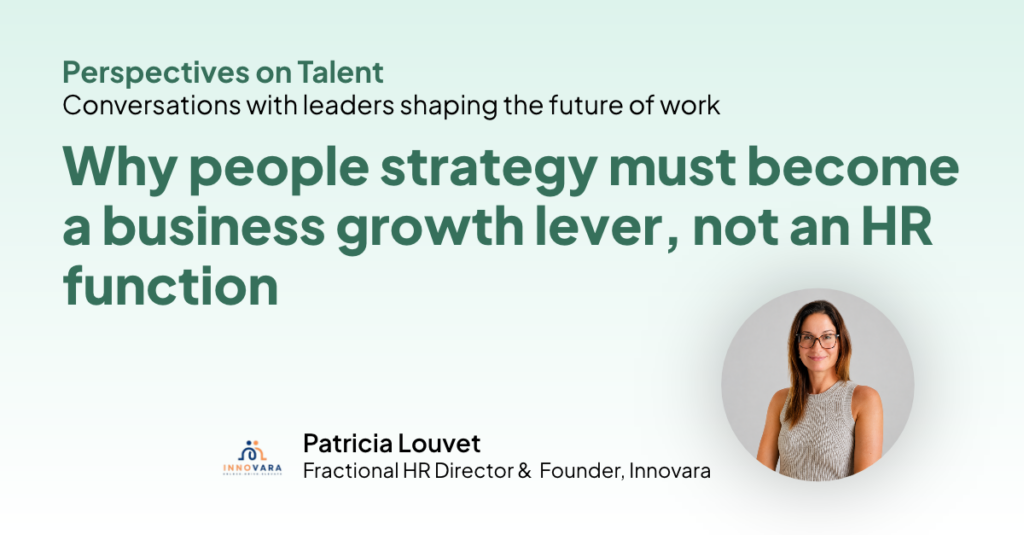
For this edition, we spoke with Patricia Louvet, a fractional HR director and a senior leadership partner about why people strategy needs to become a core part of business strategy, how organisations can build the capabilities they will need for the future, and why adaptability, judgement and human connection are becoming increasingly important as the world of work changes.
People strategy cannot be an afterthought
For Patricia, the disconnect has its roots in how the HR function has traditionally been positioned within organisations. Historically, HR has been closely associated with the operational foundations that keep an organisation running: recruitment, contracts, payroll, policies and administration.
Those responsibilities remain essential. The problem comes when they define how the entire function is perceived.
“HR has often been invited to the table once the decisions have already been made and asked: how can you support us?”
Patricia believes organisations should be asking different questions much earlier. What capabilities will the strategy require? Which roles will become more important? What talent already exists within the organisation? And what will leaders and teams need to be able to do differently six months, twelve months or several years from now?
If those conversations only happen after the strategy has been defined, a gap can quickly emerge between what the business wants to achieve and whether the organisation is equipped to deliver it.
“People strategy is part of the conversation about growth. The two go hand in hand.”
“People strategy is part of the conversation about growth. The two go hand in hand.”
A great strategy means little without the ability to execute it
Patricia has seen this gap play out first-hand. She recalls working in an organisation with what looked like an excellent strategy on paper, but where translating that strategy into results proved far more difficult. The issue was not necessarily the direction itself. It was execution.
“You can have the best strategy and the best ideas, but if you don’t have leaders who can translate that into priorities, decisions and accountability, execution becomes difficult.”
That ability to execute depends on far more than individual competence. Roles need to be clear. Leaders need to be able to navigate difficult conversations. Teams need sufficient trust to challenge one another and adapt when circumstances change.
This becomes particularly important during periods of transformation, when strategic decisions inevitably create uncertainty and change throughout an organisation. Without the right environment, Patricia argues, difficult conversations get avoided, people retreat into silos and organisations risk losing good people at exactly the time they need them most.
For her, this is where leadership and people issues have one of their clearest effects on business performance. The strategy may be sound. But the organisation still needs the capabilities to turn it into reality.
Growth requires capabilities
That word, capabilities, came up repeatedly throughout our conversation. For Patricia, organisations that successfully prepare for growth understand that they need to look beyond the skills required to perform today’s work. They need to ask what tomorrow will demand.
That means considering the capabilities of leaders, the skills within teams, the behaviours an organisation wants to encourage and the culture needed to sustain future growth. Values matter too, but only when organisations translate them into observable behaviours.
What does a company actually expect from its people? Which behaviours support the culture it wants to create? Which behaviours are not acceptable?
And alongside developing new capabilities, organisations need a better understanding of what already exists within their workforce.
“We really need to identify the internal potential. Where do we already have potential inside the organisation, and what will we need to support the growth?”
“We really need to identify the internal potential. Where do we already have potential inside the organisation, and what will we need to support the growth?”
This shifts talent conversations away from simply filling vacancies towards understanding the organisation as a whole: the people it has today, the potential within that population and the capabilities it will need tomorrow.
Bring people data into the business conversation
So how can organisations move from reactive HR towards genuinely strategic people leadership? Patricia sees three important changes.
The first is timing.
People discussions need to become part of business discussions from the beginning. When leaders are discussing growth, transformation or investment, they should simultaneously be discussing talent, organisational structure, leadership and capability.
The second is data.
“We need to use people data in the same way we use business data.”
Traditional metrics such as turnover and engagement still matter, but Patricia believes organisations should look more broadly at areas including capability, development, diversity and internal talent. Most importantly, that information needs to be considered alongside business data rather than afterwards.
“We need to use people data in the same way we use business data.”
The third change is ownership.
People strategy cannot belong solely to HR. HR can provide expertise, tools, data and challenge, but leaders throughout the organisation need to take ownership of talent, development, performance and the conversations required to help their people succeed.
In other words, strategic HR does not mean HR taking greater ownership of the business. It means the business taking greater ownership of its people.
Start with where the business is going
One example has stayed with Patricia from work she did with a large organisation in Mauritius.
A newly appointed talent and development leader had been tasked with creating an internal academy. Rather than starting with a catalogue of courses, she started with the business. She worked across different functions and business areas, speaking with leaders and other key stakeholders to understand where the organisation was going and what would need to change.
Only then did she begin designing the development offering.
The process ultimately identified a small number of priority capabilities that the organisation believed would matter most for its future. Those capabilities then became the foundation for development programmes delivered using a combination of internal and external expertise. For Patricia, the example illustrates an important distinction.
Learning and development should not begin with the question, What training should we provide?
It should begin with questions such as: Where is the organisation going? What will our leaders need to do differently? What will our teams need to be able to do? Which roles will become more important? And what potential already exists within the organisation?
The development activity comes afterwards.
Assessment creates awareness. Coaching turns it into action.
Assessments can play an important role in that process, but Patricia does not see an assessment result as an end point. She sees it as the beginning of a development journey.
“A good assessment creates awareness.”
Whether through psychometric assessments or 360-degree feedback, the value comes from helping someone understand themselves more clearly. How do I naturally operate? How do other people experience my behaviour? What are my strengths? Which of those strengths might I sometimes overuse?
But awareness alone does not change behaviour. That is where Patricia sees coaching becoming particularly valuable.
“From awareness, we can create action and change.”
Coaching creates space to turn insight into practice: trying different approaches, reflecting on what happened, making adjustments and repeating the process until new behaviours become more sustainable. Assessment can therefore provide the starting point. Coaching provides the movement. And what happens between and after those coaching conversations is ultimately what embeds the change.
“A good assessment creates awareness. From awareness, we can create action and change.”
The capabilities organisations need are changing too
The urgency behind all of this is increasing. Technology and AI are changing work quickly, and Patricia sees the effects across the organisations and partners she works with. Jobs are evolving and skills are changing alongside them. And organisations cannot rely solely on recruiting new people whenever a new capability becomes important. They also need to develop the people they already have.
At the same time, employee expectations continue to evolve. People increasingly expect development, flexibility, meaningful work and a sense of purpose. That puts new demands on leaders.
Good leadership, Patricia stresses, does not mean simply saying yes to everything employees want. It means providing structure and direction while creating an environment where people can contribute, develop and feel safe to learn. And leaders themselves cannot assume that the approach that worked a few years ago will continue to work indefinitely.
“The way you were leading two years ago may not be the right way to lead today, or one year from now.”
Continuous learning is therefore a requirement for leaders as well as a capability employees need to develop.
Adaptability, judgement and human connection will matter more
When Patricia considers the capabilities becoming most important in this environment, adaptability is near the top of the list.
Change is no longer occasional. New technology, new competitors, changing expectations and new business requirements mean people need to be able to continually adjust. Closely connected to adaptability is learning agility: the ability to learn, unlearn and learn again.
Critical thinking and judgement are becoming increasingly important too.
AI can provide people with extraordinary access to information and knowledge, but access to information is not the same as knowing what to trust or what to do with it. People need the judgement to question what they are given, distinguish reliable information from unreliable information and decide how it should be applied.
Self-awareness is another important part of the equation.
If people cannot recognise when their existing approach needs to change, it becomes much harder to adapt. But perhaps the most important capability Patricia identifies is also the most human.
As technology becomes more deeply embedded in work, the ability to connect with other people does not become less valuable. It becomes more so.
“We may become an augmented version of what we used to be, but nothing will replace human relationships.”
“We may become an augmented version of what we used to be, but nothing will replace human relationships.”
Technology will continue to evolve. Business models will continue to change. And the capabilities organisations need will evolve alongside them. Which is precisely why, for Patricia, people strategy cannot sit on the sidelines of business planning.
Her main takeaway is simple:
People strategy is business strategy.
About Patricia Louvet
Patricia Louvet Fuster is the founder of Innovara, a Fractional HR Director, Senior Leadership Partner and executive coach. A former HR Director and executive committee member, she brings more than 19 years of experience in strategic HR across 12 European countries. Based in Mauritius, she works with CEOs and leadership teams in Mauritius and Switzerland to align their people strategy with business priorities, build leadership capability and navigate organisational change. As a Gallup-Certified Strengths Coach, she helps leaders turn insight into practical changes in how they make decisions, lead their teams and develop talent.