We get this question a lot. Often from organisations who have promoted some of their high performing individuals into management roles without giving them the structured support they need to be any good at interviewing. The result is often inconsistent hiring decisions, uneven candidate experience, and interviews that rely heavily on instinct rather than evidence.
When used well, assessment data can change this dynamic, but only when managers are given practical tools (like our Interviewer Report) that translate reports into clear interview behaviour and questions, making it easy for both interviewer and interviewee alike.
Training new managers on interviewing
New managers rarely struggle because they lack intent. The challenge is uncertainty. What should they ask? How deep should they probe? How do they interpret assessment results without overcomplicating the process?
Training should therefore focus less on theory and more on decision support in real interview settings.
A practical starting point is to standardise three core components:
- A shared definition of what “good” looks like for the role
- A consistent set of behavioural competencies linked to success
- A structured interview flow that reduces improvisation
Assessment data becomes the anchor for all three. Instead of asking managers to interpret psychometrics independently, HR teams can translate outputs into guided prompts and structured question sets.
Short training sessions should focus on live examples. Take a candidate profile, review their Clevry assessment results, and walk managers through how those results translate into interview questions and follow-up probes. This builds familiarity quickly and reduces reliance on subjective judgement.
The aim is to give your managers enough structure to run a fair, focused interview without second-guessing themselves.
Using the Interviewer Report to guide questions
Assessment data becomes most powerful when it is embedded directly into the interview process rather than reviewed beforehand and left unused.
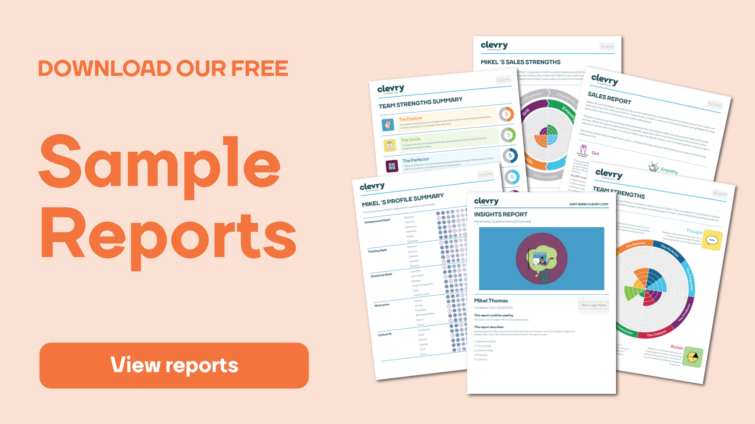
Our Interviewer Report was designed specifically for this purpose. It translates assessment results into practical, competency-relevant interview questions and guidance that managers can use during interviews.
Rather than presenting abstract psychometric scores, it generates tailored interview questions based on the candidate’s profile.
This shifts the interview from a generic conversation to a targeted exploration of behavioural evidence.
Structured interview questions linked to competencies
Each competency is supported by two or three core questions. For example, if resilience is a key requirement, the interviewer report may suggest questions exploring how a candidate responds to setbacks, handles pressure, or adapts under changing priorities.
The value of the interviewer report is that it removes the need for managers to translate raw data. It provides ready-to-use language that can be inserted directly into interview guides.
Do and do not guidance
Assessment data can be misused if taken too literally. A strong interview toolkit includes guidance such as:
- do explore patterns across multiple answers rather than focusing on a single response
- do use assessment insights as a guide rather than a decision engine
- do compare behavioural evidence in interview with assessment outputs to identify consistency
- do not over-rely on any single score or trait
- do not disclose psychometric interpretations directly to candidates in a reductive way
Building a more professional interview process
A professional interview process is not defined by complexity. It is defined by consistency, fairness and clarity.
When managers lack structure, interviews tend to vary significantly between interviewers. One manager may focus on technical detail, another on personality fit, and another on general conversation. This inconsistency creates risk in hiring decisions and weakens candidate experience.
Assessment-backed interview design solves this by standardising the inputs without removing human judgement.
A simple professional structure can be built around three stages:
- Pre-interview preparation
Managers review a short candidate summary generated from Clevry outputs. This includes key strengths, potential risks, and suggested areas for exploration. The interviewer report provides tailored questions aligned to these insights.
- Structured interview flow
Each interview follows the same format:
- opening questions to establish context and career narrative
- competency-based questions linked to assessment outputs
- deep dive questions guided by the interviewer report
- closing questions focused on motivation and role alignment
- Evidence capture and scoring
Managers record behavioural evidence against each competency rather than relying on memory or general impressions. Assessment outputs provide a reference point, but decisions are based on interview evidence.
This structure improves both confidence and quality. New managers are no longer responsible for designing interviews from scratch. They are working within a guided system that supports better judgement.
There is also a cultural benefit. When interviewers use shared frameworks and assessment-backed questions, hiring decisions become easier to justify and discuss. This improves alignment across hiring panels and reduces bias driven by personal preference.
The key shift is from unstructured conversation to guided exploration of capability.
The bottom line
New managers do not need more theory about interviewing. They need practical tools that help them ask better questions and interpret evidence with confidence.
Assessment data, when embedded properly, provides that structure. Clevry’s interviewer report turns psychometric outputs into usable interview prompts, questions and guidance that can be applied immediately.
When combined with simple training and a consistent interview framework, it creates a system where managers are supported rather than left to interpret complex data alone.
To see how this works in practice, download a sample of the interviewer report here:
https://www.clevry.com/en/resources/sample-reports/interviewer-report/
If you are looking for more information on becoming better at interviews, we have a dedicated resource on How to interview someone.